A Car, Not a Catalogue: Natural Wedding-Car Photos for Real Couples
There is a moment at almost every wedding-car photo session when the photographer says, ‘Just lean on the bonnet,’ and the couple immediately forgets what hands are for. Shoulders rise. Smiles go fixed. Someone looks as though they are waiting for a bus in formalwear. It is not your fault. A beautiful car is a demanding backdrop, and the instinct to pose stiffly beside it is strong.
The good news is that you do not need to be models. You just need a few gentle prompts, a photographer who understands cars, and a plan that treats the vehicle as part of the scene rather than a shiny obstacle. Here is how to come away with images that look like the two of you — not a brochure for the hire company.
Start with the car as a scene, not a seat
A classic saloon or a modern luxury car has its own character, and the best photos usually work with that character rather than against it. Instead of lining up face-on beside the grille, try a few simple setups:
- Walk towards the car together, hand in hand, with the photographer ahead of you.
- Pause by the rear door while one of you reaches for the handle.
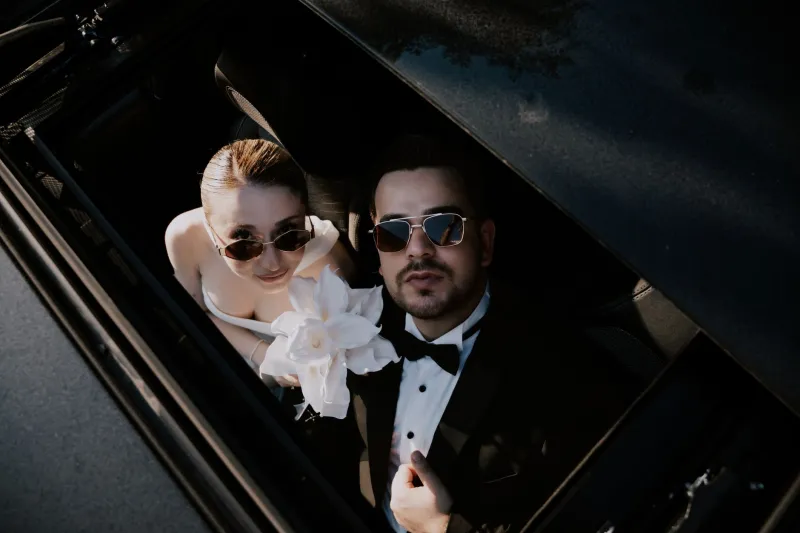
- Sit inside and look out through the window, rather than staring at the camera.
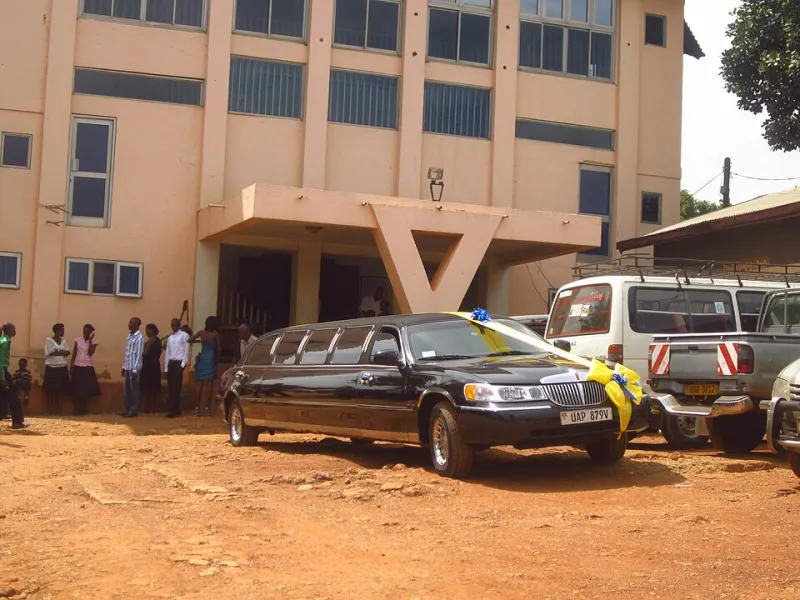
- Ask the chauffeur to stand back for a wide shot that shows the car, the venue and the two of you in context.
- Use the wing mirror or polished paintwork for a reflection shot — carefully, and without leaning on the bodywork.
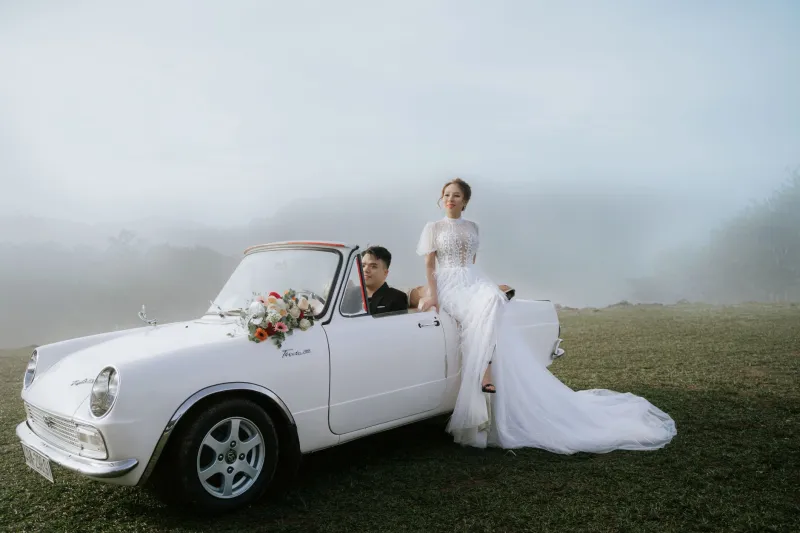
For a classic car, the upright lines and chrome trim often suit a slightly more formal mood: a hand resting lightly on the door frame, a bouquet held at waist height, a quiet look between you. For a modern luxury saloon, the shapes are sleeker, so try standing near the rear quarter, using the glass as a frame, or sitting in the back seat as though you are about to leave for dinner. The point is not to copy a pose from a magazine. It is to give yourselves something to do so your faces can relax.
Find your light before you find your pose
British wedding light is famously cooperative in a soft, grey, flattering way — and famously unhelpful at midday in July. If your schedule allows, ask your photographer to scout the car’s parking spot during the day. A car in open sun can turn into a mirror of hard highlights, while the same car under light cloud or open shade gives you softer skin tones and more detail in the paintwork.
Late afternoon and early evening are usually kindest, but they are also when guests, speeches and canapés compete for your attention. Build in fifteen to twenty minutes rather than an hour. In winter, remember that light can fade by mid-afternoon, so do not leave car photos until the very end of the day unless you are deliberately going for a dusk shot with the lights on.
Hands, bouquet and the awkward bit
Most stiffness comes from uncertainty about hands. Give them a job. One hand lightly on the door handle. One hand holding the bouquet. One hand in your partner’s. A hand adjusting a cufflink or a veil. Avoid gripping the ribbon, leaning your full weight on the trim or resting rings directly against paintwork.
Your bouquet is a brilliant anchor. Hold it low and slightly to one side, or rest it on the seat beside you rather than on the roof or bonnet. If the flowers are damp or the dyes are strong, keep them off the paintwork entirely. Ask the chauffeur to remove ribbons if you want a cleaner look for portraits; they can go back on before the departure.
Brief your photographer in plain English
You do not need a technical brief, but a short list helps. Tell them which side of the car photographs best, whether the chauffeur can move it a few metres, and how long you have before the car is needed. Mention any details you love — the chrome, the leather, the ribbon, the number plate — and any you would rather avoid.
Ask for prompts rather than poses. ‘Whisper something rude about the seating plan’ tends to produce better pictures than ‘smile at the camera.’ A photographer who encourages movement — walking, opening a door, stepping back, laughing at the wind — will give you images with life in them. If they are used to fashion shoots and want you draped across the bonnet, politely decline. You are not there to sell the car.
Protect the paint without becoming dull
Car hire firms are understandably careful about paintwork, and you should be too. Do not sit or perch on the bonnet. Keep keys, rings, bags and drinks away from the bodywork. Avoid confetti near the car, especially the metallic kind that finds its way into every crevice. If it has rained, wipe your hands before touching the trim, and ask the chauffeur before moving any ribbons or flowers.
None of this makes the photos boring. It simply means you can relax without worrying about a scuff. A good chauffeur will often have a microfibre cloth and a quiet sense of what is acceptable. Use them as an ally, not a background extra.
Leave room for the unplanned frame
Some of the best car photos happen in the gaps: the chauffeur opening the door, a guest peeking out of the window, the two of you caught mid-laugh as a gust takes the veil. Tell your photographer to stay close for the boarding and departure, not just the staged portraits. Those in-between moments are the ones that will feel like your day.
Finally, remember that the car is there to serve the wedding, not the other way round. If the schedule tightens or the rain sets in, take the photo by the open door and move on. A relaxed couple beside a beautiful car will always look better than a stressed couple chasing a perfect shot. The best image is the one where you look like yourselves — just with excellent transport.