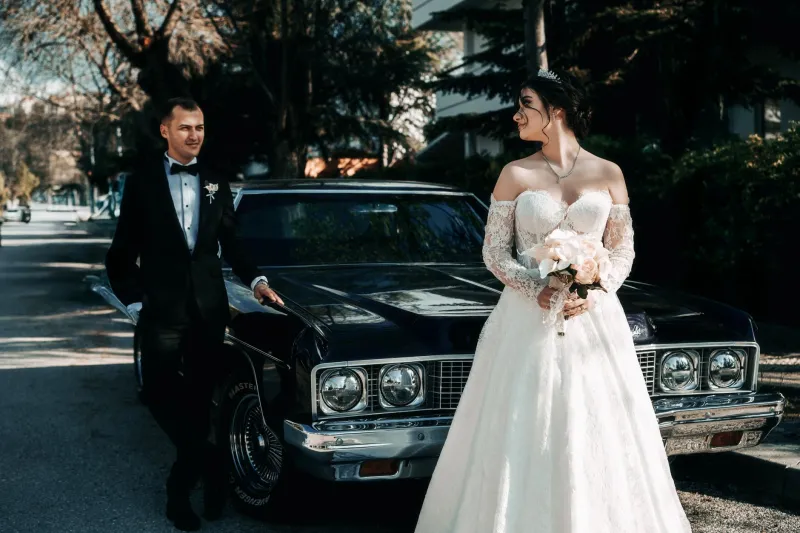
Keys, Cover and a Clear Conscience: Borrowing a Family Classic for the Big Day
Photo: Leslie Barrie , CC BY-SA 2.0, via Wikimedia Commons
There is a particular kind of magic to arriving at a village church in a car that smells of old leather and somebody else's memories. A grandparent's Morris Minor, an uncle's lovingly polished MGB, a neighbour's Rover that has never once been seen dirty — these are the cars that make wedding guests look up from their phones. But before the ribbon goes on, there is a less romantic question to answer: whose insurance is actually covering this little piece of family history?
Borrowing a classic is not the same as hiring one. It is warmer, cheaper and considerably more personal — but it also comes with a paper trail that nobody wants to be untangling on the morning of the wedding. The good news is that a few calm conversations and a bit of admin will usually sort it.
Start with the honest conversation
Before you start choosing ribbon colours, talk to the owner about money. Not because you have to pay them, but because paying them can change everything. Most private car insurance policies cover "social, domestic and pleasure" use. That generally includes driving to a wedding. It usually does not include being paid to drive people to a wedding, which insurers tend to call "hire and reward".
If you hand your uncle £100 towards the petrol and he treats it as a gift, that is one thing. If it looks like a fee for a service, you may have quietly turned a private classic into an uninsured taxi. Keep it simple: either the owner drives you as a guest doing a favour, or you borrow the car with no money changing hands. If money is involved, ask the insurer directly — do not guess.
Whose name is on the policy?
The safest arrangement is usually the owner driving. Their insurance already covers the car, their driving history is known, and there is no last-minute scramble to add a named driver. If the owner is happy to chauffeur you, that is often the neatest solution — and it gives you someone who knows the car's quirks, from the choke to the slightly sticky second gear.
If you are driving, you need to be a named driver on the policy. Do not rely on "driving other cars" cover. That perk, where it exists at all, often provides third-party cover only. On a cherished classic, third-party cover is not much comfort if you scrape a wall. It may also exclude cars that are not owned by you, or exclude classic and modified vehicles entirely. Read the certificate, not the summary.
Tell the insurer what the car is doing
Wedding use is usually fine under social, domestic and pleasure cover, but it is worth a phone call. Say plainly: "I am borrowing my father's classic car to drive to my wedding. Is that covered?" Get the answer in writing if you can. Insurers are used to odd questions; they are less used to being asked after the event.
Ask about mileage limits too. Many classic policies have an annual cap — 3,000 or 5,000 miles is common. A wedding 200 miles away, plus a photoshoot detour, can eat into that. If the car is on a limited-mileage policy, check you are not pushing it over the edge.
Agreed value, excess and the small print
Classic cars are often insured on an agreed valuation basis. That is a good thing — it means the insurer and owner have already agreed what the car is worth, rather than arguing after a claim. But it also means the owner may need to update the valuation if the car has recently been restored or its market value has moved. A freshly painted MG insured at its 2019 value is a false economy.
Check the excess as well. Some classic policies carry a higher excess than everyday car insurance, and a young driver may push it higher still. If you are under 25, be prepared for the insurer to say no, or to charge a premium that makes the family favour feel less generous.
The boring bits that stop the day
Paperwork is only half of it. A classic car needs to be legal and roadworthy, not just pretty. Check the MOT status — many older classics are exempt, but only if they have been declared as such and the owner has kept the paperwork straight. Tax and SORN status matter too. A car that has been off the road for two years is not a wedding car until it has been properly recommissioned.
Tyres are the quiet killer. Classic cars often sit for long periods, and old rubber can look fine while offering very little grip in a British drizzle. Ask when they were last replaced. Then ask about breakdown cover. Many classic policies include UK recovery, but check that it covers the whole route — not just a five-mile tow to the nearest garage. If the car is older and less predictable, a standalone classic breakdown policy is cheap peace of mind.
A short pre-wedding checklist
- Is the owner driving, or are you a named driver?
- Does the policy cover social, domestic and pleasure use for a wedding?
- Is there any payment involved? If so, has the insurer confirmed hire and reward cover?
- What is the agreed valuation, and is it up to date?
- What is the mileage limit, and does your route fit inside it?
- Is the MOT, tax and SORN status correct?
- When were the tyres last replaced?
- Is breakdown recovery in place for the full journey?
- Does the car have working seatbelts for every passenger?
The verdict
Borrowing a family classic is still one of the loveliest ways to arrive at a wedding. It is personal, it is photogenic, and it saves you the cost of a hire car. But it works best when the romantic bits — the ribbon, the bloom, the slow drive up the venue's gravel — sit on top of a dull, tidy layer of insurance and maintenance.
Do the paperwork early, keep the owner involved, and do not be shy about asking the insurer a direct question. A few careful phone calls now mean you can spend the wedding morning thinking about the vows, not the small print.